The Ritual Shields
Azuki Vermilion, Setsubun Decoupling, and the Cryptographic Code of the Sacred Bean
While we look with awe at the fluid alchemy of rice fermentation
—where complex contexts melt into sake and sweet liquids…
We must also confront a different paradigm embedded deep within the Far East’s spiritual operating system:
the use of the bean, a small, hard, and perfect sphere of matter, as a “boundary architecture” and an amulet against chaos.
In sharp contrast to Western defence protocols that erect towering stone walls and impregnable fortresses (Gō / Addition / Hardware), the Japanese developed an invisible system of “Cognitive Security” (Jū / Subtraction / Software).
Using nothing more than the specific pigments, linguistics, and geometry of a simple bean, they successfully fortified their lived spaces against the intrusion of systemic errors, pestilence, and spiritual clutter.
Act I:
The Crimson of Azuki
The Visual Firewall
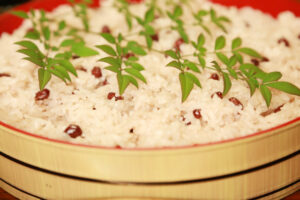
Why do the Japanese invariably consume Sekihan (Sacred Crimson Rice) on days of profound transition, celebrating the milestones of life (Hare)?
The answer utilizes the exact same cognitive encryption that painted the majestic Torii gates of Shinto shrines in brilliant vermilion.
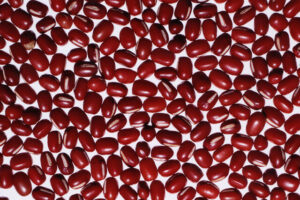
In ancient Japan, the deep crimson of the Azuki (Akatsuki) bean was recognised as a “Visual Firewall.”
It was a chromatic barrier representing the blinding radiance of the sun and the raw vital force of blood
—a symbolic shield thrown up to ward off invisible cognitive drift, illness, and decay.
A Linguistic Cryptographic layer
But beneath this chromatic shield lies an even deeper, linguistic cryptographic layer:
the primal code of “Aka-tsu-ki.”
-
A / Aka (赤 / 開):
The sound of opening, of the rising sun, of the sovereign red that dispels darkness. -
Tsu (粒):
The condensed, physical particle; the ultimate micro-sphere. -
Ki (気 / 木):
The vital force of life-energy, rooted in the earth.
This creates a breathtaking metaphysical symmetry with the astronomical phenomenon of dawn:
“Akatsuki” (暁)
—the sacred twilight where the moon (Tsuki) is subtracted, and the world is reborn in red light (Aka).
To the ancient people of the islands, the wild bush-growing bean was not a mere foodstuff.
It was “Aka-tsu-ki”
—the crimson seed of vital energy, a miniature, physical capsule containing the sun’s absolute fire, condensed by the earth into a single, un-compromised grain.
The Pre-Systemic Purity of the Native Seed
Here, we witness a profound and stubborn cognitive resistance:
the dual-booting of the Japanese mind.
When the continental written OS arrived, Japanese administrative networks adopted the visual characters of “small bean” (小豆) to align with the global trade and bureaucratic grid of the era.
Yet, they fiercely and stubbornly refused to let the written symbol overwrite their spoken frequency.
They looked at the characters for “small bean” ( 小豆/ Shōzu), but they insisted on reading them—as they do to this day—using the ancient acoustic vibration of Azuki (Aka-tsu-ki).
This is not a mere linguistic anomaly;
it is an act of Aesthetic Sovereignty.
They allowed the foreign system to structure their external “hardware” (the kanji database), but kept their internal spiritual “software” (the spoken Yamato-kotoba frequency) absolutely un-corrupted underneath.
The Spiritual Firewall
When the Japanese eat Sekihan at major life transitions, they are not merely performing a quaint culinary custom.
By introducing the physical “Aka-tsu-ki” (the vermilion seed) into their biological systems at the exact moment of chronological transition, they install a spiritual firewall.
They rewrite their internal software, purging the “night” of accumulated errors, and restarting their consciousness from the pristine zero-point of a new daybreak.
Act II:
The Alchemy of Shibunuki
The Subtraction of Tannin
To prepare the Azuki (Aka-tsu-ki) bean for sweet consumption, however, the master confectioner must perform a delicate chemical and aesthetic intervention:
the process of “Shibunuki” (渋抜き / Subtraction of Astringency).
Unlike Western chocolatiers who build flavour through addition—layering heavy cocoa fats, excessive cane sugars, and dairy lipids to smother the palate in sensory overload (Gō / Addition)—the Japanese sweet-maker operates through relentless purification.
The raw Azuki bean is naturally saturated with shibu
—astringent tannins that leave a harsh, dry, and bitter static on the tongue.
In its raw state, the bean is too aggressive, its botanical code too unpolished for the sacred sanctuary of the tea gathering.
To resolve this, the craftsman subjects the beans to multiple boilings, repeatedly throwing away the dark, bitter water.
This is the art of “Aesthetic Debugging.”
By washing away the astringent tannins, the sweet-maker systematically subtracts the botanical “noise” of the seed.
They do not add fat to mask the bitterness;
they extract the bitterness itself, leaving behind only the pure, velvety essence of the starch.
The resulting sweet paste (Anko) is a monument to subtractive luxury.
It does not aggressively stimulate the brain’s pleasure centres like industrial chocolate.
Instead, it offers a quiet, gentle sweetness (Amami) that is perfectly tuned to soothe the palate, acting as a physiological safeguard before the intense, purifying shock of bitter green matcha.
Act III:
The Light-Absorbing Shield of the New Year
As the year cycles back to its dark, winter origins, a third shield is placed upon the lacquerware tables of Japan:
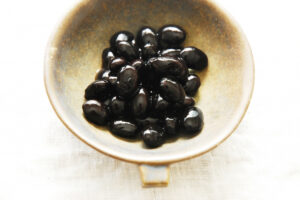
Kuromame (sweet, black soybeans), served as a cornerstone of the New Year’s Osechi feast.
To prepare Kuromame, the black soybeans are slowly simmered in iron pots alongside rusty iron nails.
This chemical alliance between the bean’s natural anthocyanin pigments and the iron ions creates a surface of deep, impenetrable black
—a lustrous, lacquer-like obsidian finish.
Placed inside a crimson or gold-tiered box, this silent black absorbs the incoming rays of festive light.
It balances the blinding optimism of the New Year (the noise of addition) by anchoring it to the deep, unyielding shadow of the earth (the truth of subtraction).
In the aesthetics of Reviendrai, the obsidian is the ultimate chromatic sink (the Void).
Act IV:
Setsubun Decoupling
The Kinetic Firewall of Parched Soybeans
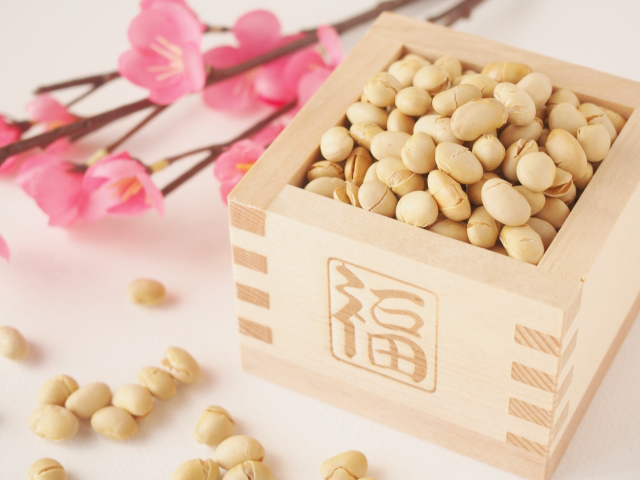
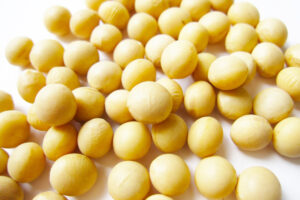
While the native Azuki serves as an internal, biological firewall, its sister grain—the hard, golden soybean (Daizu/大豆)—is deployed as an external, kinetic system of boundary defence.
In the dead of winter, during the ritual of Setsubun (the seasonal decoupling that marks the eve of Spring), a strange combat protocol is activated across the households of Japan.
The master of the house takes handfuls of parched, rock-hard soybeans and violently hurls them against the open doorways and dark corners of the home, shouting:
“Oni wa soto, Fuku wa uchi”
(Demons out, Blessings in).
The Oni (demon) in Japanese metaphysics represents the invisible accumulation of systemic noise, social friction, epidemics, and psychological decay that naturally builds up inside any closed human network over the course of a year.
If left unchecked, this noise threatens to corrupt the community’s operating system.
The thrown soybean is a projectile of pure, unyielding hardness.
By dry-roasting (parching) the beans, the Japanese force-quit their biological potential.
They subtract the moisture of growth, turning the soft seed into an imperishable, mineralised shield.
When these parched spheres strike the thresholds of the house, they create a sharp, physical acoustics of impact.
This is not a gesture of violence;
it is a “spatial initialisation.”
The hard bean acts as a physical buffer, absorbing the chaotic, formless “noise” of the environment and anchoring it back to the ground.
To the Western observer, this appears to be a naive, superstitious game.
But through the lens of cognitive security, it is a masterfully engineered “Kinetic Decoupling Mechanism.”
The boundary is re-asserted.
The system is decoupled from the winter’s decay, and the home’s interior is successfully insulated to receive the fresh, un-polluted inputs of Spring.