The Sweetness of Subtraction
The Alchemy of Amazake, Mirin, and the Aesthetics of Amber
If Western pâtisserie and Asian court desserts command the palate through “addition“
—using refined cane sugar to aggressively excite, overwhelm, and stimulate the brain’s pleasure centers…
The Japanese have quietly perfected a different paradigm:
Amami (sweetness) through subtraction.
By extracting natural sweetness solely from the alchemical marriage of rice and kōji mold, Japanese fermentation culture achieves a “subtractive sweetness“ (Sweetness of Subtraction).
This is an organic alchemy that bypasses the external “addition” of cane sugar.
It is the most tender way to install the vital energy of the earth directly into our biological systems, completely free from the hyper-accumulation of industrial noise.
Act I: Amazake
The White Microcosm of Inadama
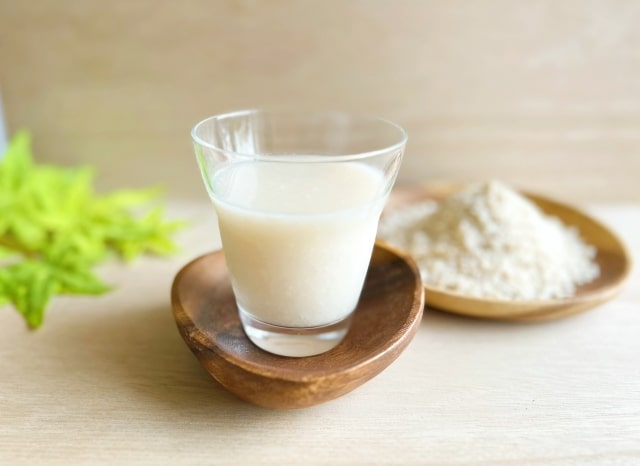
Amazake is often called “drinking IV drip” (nomu-tenteki) in modern Japan, celebrated for its dense concentration of glucose and amino acids.
Yet, its physical reality is far more mystical:
it is a white microcosm of pure, unadulterated life force.
In making amazake, not a single grain of cane sugar is added.
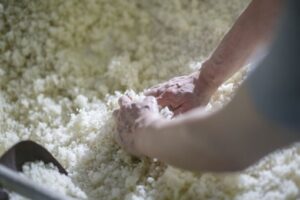
The master fermenter simply introduces kōji to steamed rice, allowing the invisible enzymes to break down complex starches into natural sugars.
This white, pristine liquid is the liquid infrastructure of Japanese Shinto rites.
Served at the cold thresholds of shrines during winter festivals and Hanamatsuri (Flower Festivals), it is an ancient sacrament.
To drink warm amazake in the freezing air of a sacred forest is to partake in the raw vital force of inadama (the soul of rice).
It is a sensory reboot
—restoring our bodies to their natural, pristine state of zero-point clarity, aligning our internal frequencies with the sacred cycles of the Shinto-Buddhist soil.
The Sweet Zero-point Code
Within the Reviendrai journey, Amazake operates as our Primal Initialization.
It is the white, sweet zero-point code we place before the world-weary traveler.
By flooding their system with this unadulterated vital energy, we execute a profound metabolic reset, clearing the lingering static of industrial foods and restoring the body to its natural state of zero-point clarity.
Act II: Mirin
The Forgotten Amber and the Liquid Time Machine
In modern culinary handbooks, Mirin is vulgarly treated as a mere cooking condiment
—a cheap syrup used to add gloss and mild sweetness to sauces.
But this is a tragic system error.
The true origin of Mirin lies in the Edo period, where it was revered as Toso or Miri
—a dense, sweet, and incredibly luxurious liqueur enjoyed exclusively by the nobility and women of high status.
The creation of authentic Mirin is a painstaking, triple-fermentation process.
Steamed glutinous rice (mochigome), rice kōji, and authentic distilled rice shochu are combined and left to mature in absolute, hermetic darkness, sometimes for several years.
Without relying on a single pinch of sugar, the glutinous rice surrenders its rich starches, converting them into complex sugars and amino acids while dissolving into a velvety, golden-brown nectar.
This slow, silent maturation is a form of temporal preservation.
Just as the city of Siena froze the most beautiful, pristine moment of the Middle Ages into a permanent, golden amber.
Authentic Mirin is a liquid time machine.
It is the absolute capture and preservation of agricultural time, suspended in a glass of dark, glowing amber.
Act III:
The Gradation of Liquid Time
The Somatic Synchronization
When we look at the alchemical transmutation of rice under the quiet, invisible instruction of wild microbes, we uncover a stunning spiritual spectrum
—a profound gradation of liquid time:
- The Pure White (Amazake):
The primal, sweet origin—raw vital energy (Inadama). - The Transparent (Sake):
The purified, crystalline spirit—the cold, winter logic of mountain water. - The Deep Amber (Mirin):
The ultimate, aged synthesis—the warm, sweet memory of autumn earth.