Liquid Time
The Phenomenology of Sake and the Security Decryption of the Izakaya
To speak of Sake merely in terms of numerical specifications—the “rice polishing ratio” of Daiginjo or Junmai, or the cold, sterile facts of industrial brewing—is considered vulgar within the aesthetic of Reviendrai.
Sake is not a product of mathematical calculation.
It is “Liquid Time”
—the mystical fermentation of the earth’s memory, surrendered to wild microbial life (yeast and kōji mold) far beyond human control.
And the space into which this liquid is poured—the “Izakaya”—functions as a “Reverse Nijiriguchi“;
a sacred, everyday reset infrastructure designed to dissolve the individual ego, quiet the noise of worldly life, and synchronize human souls into a state of deep, collective harmony.
Act I:
Surrendering the Ego to Microbes
The Sublime Grace of Parallel Fermentation
While Western winemaking historically seeks to dominate and control nature through the lens of terroir and calculated temperature-controlled aging
—a monument to human sovereignty (Gō / Addition / Active Control)…
The creation of Japanese Sake is born from the ultimate self-surrender to nature (Jū / Subtraction).
Its crowning technological achievement, Multiple Parallel Fermentation (heikō-fuku-hakkō), is a process where the conversion of starch to sugar (by kōji) and sugar to alcohol (by yeast) occur simultaneously in a single, open vat in perfect, organic unison.
It is an intricate, invisible orchestra operating far beyond the limits of human calculation.
Attuning the environment (fushin)
The Tōji (master brewer) does not subdue the vat with brute force.
Instead, he simply “attunes” the environment (fushin), aligning the mountain’s cold winter drafts, the pristine mountain water, and the chaotic vital forces of the microscopic world.
He subtracts his own ego, allowing the microbial life to write the code.
In this light, the extensive polishing of rice for Daiginjo is not a pursuit of vanity, but a profound act of subtraction.
By stripping away the outer layers of fat and protein from the grain, the brewer purifies the kernel to capture only the most pristine, frozen moment of cold water and winter air.
This is subtractive governance, sealing the “Origin of Time” into liquid form.
Act II:
The Izakaya as a “Reverse Nijiriguchi”
The Soft Dissolution of Societal Armor
If the traditional tea room (Chashitsu) is a highly isolated, tense, and sacred sanctuary of non-ordinary space
—a spiritual sanatorium…
The Izakaya is a tender, everyday platform designed to temporarily pause (force-quit) social roles and the illusion of the ego.
In the 17th and 18th centuries, London coffee houses and Parisian cafés acted as public squares of “addition.“
They were spaces of logos (reason), where citizens gathered to compile political theories, debate intensely, and fuel the fires of intellectual revolutions.
The Japanese Izakaya, however, functions as a “subtractive vacuum.”
Here, the weight of logic, societal titles, and rigid egos are gently melted away by the warmth of “Liquid Time.”
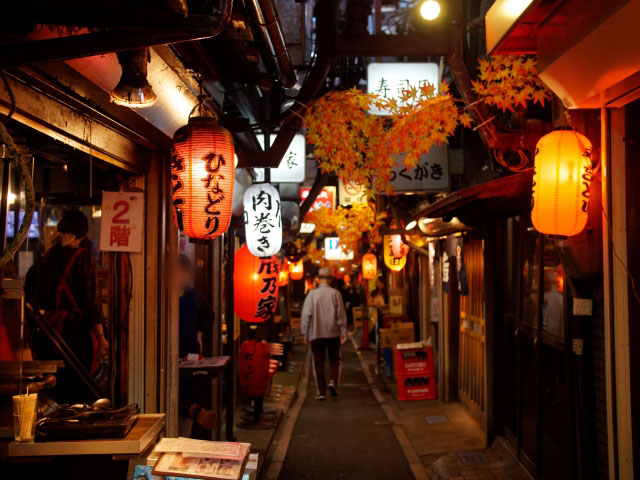
Passing through the noren (the split curtain) of an Izakaya is the secular equivalent of crawling through the tea room’s Nijiriguchi (躙口).
It is a security bypass
—a sensory gesture where one shrugs off the heavy signs of status to return to raw, unadulterated humanity.
Under the dim red lanterns (aka-chōchin), even within the incredibly rigid class system of the Edo period, the Samurai laid aside his swords and sat shoulder-to-shoulder with commoners, sharing the same cup.
A Sandbox of Single Men
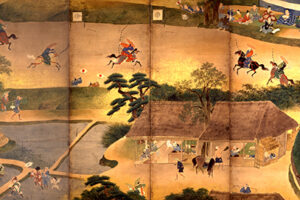
This was particularly vital in Edo
—a highly disciplined, tense sandbox of single men.
Governed by the strict “Edo Castle OS” of Sankin-kōtai (alternate attendance), the city had an exceptionally high rate of lonely bachelor Samurais.
Moreover, Edo was a city of constant fires and rapid reconstruction
—a relentless cycle of scrap-and-build.
This disaster-prone economy created an endless demand for carpenters and day-laborers, drawing in the younger sons of rural farmers from the provinces who had no secure land to inherit.
These men lived hand-to-mouth, famously embracing the ethos of “not keeping one’s earnings overnight” (Yoigoshi no kane wa motanai)
—a radical, daily subtraction of material accumulation.
Ichiza Konryu (一座建立)
The Izakaya arose as their indispensable daily sanatorium;
a sacred decompression chamber where these exhausted builders and warriors alike could shed their defensive armor and access a state of Ichiza Konryu (一座建立).
Here, sharp, verbal conflicts are dissolved into the warm silence and shared laughter of sake being poured from tokkuri (flask) to ochoko (cup)
—synchronizing every soul to the exact same frequency.
Act III:
The Interpersonal Smart Contract
The Geometry of the Western wine glass
In the Western banquet, wine or spirits are poured into massive, individual glasses
—a permanent reservoir of personal ownership (the Weight of Addition).
To be sure, modern global gastronomy has successfully married Japanese Sake with the elegant geometry of the Western wine glass.
This is a highly calculated, additive marketing strategy
—an industry-driven response to the societal shift toward individualism and the “unbinding” of corporate and familial obligations.
By pouring sake into a single-owner wine glass, the liquid is isolated, allowing the individual to deeply contemplate its aromatics in absolute isolation.
It is a beautiful monument to the Completed Ego.
The Architecture of Shared Void
The Japanese sake banquet, however, rejects this individualistic isolation.
It compiles an exquisite, decentralized peer-to-peer protocol of mutual care, governed by the precise synchronization of hardware and software.
If the vessel’s capacity is so small, it is emptied in just one or two sips, instantly generating a physical “void” (empty space).
To pour sake for oneself (tejaku) is treated as a systemic error
—a self-centered loop that breaks the shared field.
Instead, the empty socket of the cup becomes a silent API call, demanding a response from the other.
The moment a void is detected, you fill it with “Liquid Time.”
Your partner, executing the exact same recursive loop, immediately returns the gesture when your cup is emptied.
This wordless, decentralized giving and receiving (Oshaku) functions as a perfect interpersonal smart contract.
It systematically erodes the boundary of the self and synchronizes the entire table into the shared, fleeting eternity of Ichigo Ichie (一期一会).
Act IV:
Thermal Modulation
From Crystalline Winter to the Earth’s Warmth
Sake is a rare, almost miraculous gastronomic medium that can be dynamically modulated across a thermal range of over 30°C (from 5°C to 50°C).
- Reishu (Cold):
Crystalline and sharp, cold sake renders the pure, subtractive silence of the polished rice kernel
—the crystalline, logical beauty of winter mountain water. - Atsukan (Warm):
Rising in gentle vapor, warm sake installs the earth’s hidden warmth and soft emotion (receptive grace) directly into the body’s cellular network.
Within the Reviendrai experience, this thermal modulation is our somatic bridge between seasons.
As the liquid, modulated to the exact degree of your soul’s temperature, flows down your throat, you feel your physical form dissolve.
The boundaries of the self melt away, flowing back into the 1,000-year-old bloodstream of the mountains and the nameless ancestors who sat atop this very fault line.