The Phenomenology of Tea
Matcha, Chaji, and the Unlocking of Temporal Capsulation
As a matter of cold, objective fact, what is Matcha (抹茶)?
If we strip away all cultural sentimentality, it is nothing more than pulverized tea leaves dissolved in hot water—a bitter, warm, green mud.
Yet, when the world’s most refined minds sit before this simple ceramic bowl, they do not see a bitter beverage.
Instead, they find themselves shedding their social armor, feeling a profound sense of awe, and discovering the entire cosmos folded inside a single, emerald-tinted reflection.
This is the ultimate triumph of “Contextual Alchemy” (the alchemy of meaning).
By encasing an ordinary physical act within a dense network of geological, historical, and spiritual codes, the Japanese transformed the simple consumption of leaves into a shamanic pilgrimage of the soul.
Act I:
Sado vs. Chaji
The Twin Spirals of the Infinite Path and the Temporal Event
In Western translation, the word “tea” is often flattened.
But within the Far East’s cognitive operating system, the transition between two Japanese suffixes—Dō (道 / Path) and Ji (事 / Event)—represents a profound, structural inversion of time and space.
Sadō (茶道)
The Infinite Path (The Sovereign OS)
When the Japanese append the word Dō (Way) to a concept—whether Shintō (The Way of the Gods), Bushidō (The Way of the Warrior), or Sadō (The Way of Tea)—they are defining an infinite, lifelong path of practice.
It is the “source code” of the spirit, a continuous and un-terminating loop of self-refinement designed to run in the background of one’s entire existence, a majestic program of Aesthetic Resistance.
Chaji (茶事)
The Shamanic Runtime (The Immersive Event)
On the other hand, Ji represents “the event.”
Chaji is the physical, real-time deployment of the infinite path into a closed, four-hour ritual.
A Chaji is not a brief tea-tasting;
it is the ultimate Zen dinner-retreat.
The host does not merely whisk tea.
They serve Kaiseki (a highly conceptual multi-course meal), pour local sake, build the charcoal fire, and guide the guests through a tense, highly curated progression from worldly noise to spiritual silence.
If Sadō is the operating system, Chaji is the exclusive, high-density program that boots up for one specific afternoon to rewrite the guest’s cognitive reality.
Act II:
Kuchikiri-Chaji
Unlocking the Amber of Time
Within the cycle of the year, the most sacred Chaji occurs in November.
It is called Kuchikiri-Chaji (口切茶事 / The Festival of the Broken Seal)
—revered by practitioners as the “Tea Master’s New Year.”
Tencha (碾茶)
In May, the year’s finest spring harvest is processed not into standard tea, but into Tencha (碾茶).
In this exquisite process of physical subtraction, the stems are meticulously stripped away, leaving only the pure, soft, chlorophyll-rich flesh of the leaf.
These unground Tencha leaves—the quiet, pre-compiled data of Matcha—are placed inside a massive clay jar (Chatsubo), sealed under layers of sacred paper, and sent high into the cold, silent depths of the mountains.
There, the tea sleeps through the sweltering humidity of summer, slowly undergoing a silent, microscopic ageing and maturation beyond human reach.
It is the same temporal preservation that froze the medieval grace of Siena into a permanent, pristine amber.
The force-release of capsulated time
In November, when the mountain winds turn cold, the jar is brought down to the tea room.
In front of the guests, the host takes a small knife and slits open the paper seal.
By slitting the seal, the host performs “the force-release of capsulated time.”
The leaves, ground into a vibrant emerald powder under a stone mill just minutes before the guests’ eyes, carry the precise, frozen memory of spring mists and summer mountains.
To drink this tea is to consume liquid, preserved time.
Act III:
Cha-Kaiseki
The Defensive Shield of the Empty Stomach
In modern culinary tourism, the term Kaiseki is often misunderstood as a lavish, over-plated feast designed to show off the host’s wealth (the weight of addition).
The true origin of this gastronomy, however, is Cha-Kaiseki (茶懐石)
—an exquisite, subtractive pre-tea meal designed by Rikyū.
Cha-Kaiseki was engineered for a purely functional, defensive purpose:
to protect the guest’s stomach.
Koicha (the thick, pure matcha) is an incredibly powerful, chemically dense substance.
If poured directly into an empty stomach, its raw, purifying energy would cause a physical shock, causing the heart to race and the body to panic.
Therefore, Cha-Kaiseki acts as a “physiological cushion.”
Ichiju-Sansai (一汁三菜)
Based on the strict, minimalistic rule of Ichiju-Sansai (one soup, three small dishes), it subtracts all unnecessary fats, sugars, and heavy oils.
It serves only the absolute, local essence of the season at its peak
—providing just enough nourishment to line the stomach without dulling the sensory receptors.
It has a sacred covenant:
the guests consume every single drop, leaving the lacquered bowls completely clean.
This zero-waste exchange is a silent gesture of gratitude, completing a beautiful loop of mutual respect before the divine tea is served.
Act IV:
Koicha and Usucha
As the Chaji reaches its climax, the guests undergo a beautiful, two-stage transition of consciousness, shifting from the collective to the individual:
The Communion:
Koicha (濃茶 / Thick Tea)
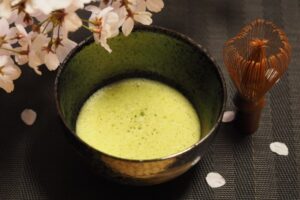
Koicha is a dense, velvety, and almost viscous liquid, resembling liquid jade.
In this ritual, there is only one bowl.
The primary guest takes three sips, wipes the rim, and hands it to the next.
One by one, the guests share the exact same vessel, tasting the exact same liquid.
In this moment, the boundary of the self completely dissolves.
Social status, nationality, and individual egos are utterly melted into a single, shared bloodstream.
This is the ultimate collective synchronization
—an unbreakable, un-bombable covenant of mutual trust:
Ichiza Konryu (一座建立).
The Release:
Usucha (薄茶 / Thin Tea)
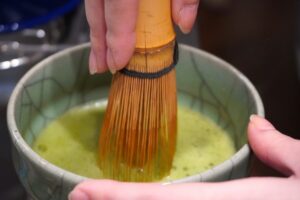
After the intense, sacred tension of Koicha, the host cleanses the space and whisks Usucha (Thin Tea).
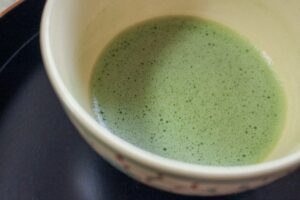
This is a light, frothy, and refreshing bowl, served individually to each guest.
Having surrendered their egos and merged their souls during the Koicha phase, the guests are now gently returned to their individual sovereignty.
Usucha is a soft landing, a comforting return to the everyday world, allowing the guests to retain their inner peace while preparing to step back across the threshold of the Roji path.
It is the perfect embodiment of Zanshin (the lingering echo)
—leaving the sanctuary not in abrupt shock, but in a gradual, beautiful decline of intensity.