The Scarred Clay
Pottery, the Tectonic Scars of the Earth, and the Physical Anchor of Impermanence
Until now, the sublime “subtractive intelligences” we have decompiled—tea, rice, sake, and the fermented alchemies of miso and soy sauce—have existed as invisible liquids and fleeting moments of time.
They are the “software” (spirit) of the cosmos.
What, then, is the “hardware” (vessel)” engineered to receive this sacred liquid time and hold the zero-point silence of Ichiza Konryu?
It is Pottery (Yakimono)
—the physical fixing of the earth’s raw tectonic scars through human discipline and the absolute gravity of fire.
It is the ultimate physical anchor that the Japanese created to bind the invisible beauty of impermanence (Mujō) directly into our material world.
Act I:
The Tectonic Scars and the Three Kilns
Fixing the Friction of the Earth into Form
The geographical baseline of the Reviendrai pilgrimage—anchored upon the brackish shores of Hamamatsu and Kosai, and tracing the Median Tectonic Line (MTL)—is where the physical friction of the earth crystallizes into form.
This is the most massive geological scar on Earth, ripping the Japanese archipelago in two.
Along this line of violent geological friction, where tectonic plates collide under immense heat and pressure, the earth has exposed highly refined, pristine veins of clay (nendo)
—crushed and purified over millions of years by wind, rain, and seismic shift.
It is no coincidence that out of Japan’s legendary Six Ancient Kilns (Rokkōyō)
—the six ancestral heartlands of clay that have kept their fires burning continuously since the 12th century (Bizen, Shigaraki, Tanba, Echizen, Seto, and Tokoname)—
two of the most vital sit directly upon this tectonic boundary.
True sanctuaries are never born from flat, quiet lands;
they crystallize on the scarred thresholds of the Earth.
Tokoname:
The Red Iron and Cosmic Breath
Born from raw, iron-rich clays, Tokoname pottery is fired to a metal-like hardness.
Yet, its dense, rustic skin remains highly porous on a microscopic level.
It “breathes” in union with the tea or sake poured into it, systematically subtracting bitter tannins and impurities to attune the liquid to a perfectly rounded flavor profile.
Seto:
The White Canvas and the Glazed Shield
In contrast to Tokoname’s earthen mud, Seto boasts pure white, heat-resistant clays.
It was here that Japanese artisans first mastered the alchemy of liquid glass (ash and mineral glazes).
By draping Seto’s white clay in a protective, translucent membrane, they created a fluid canvas where fire and minerals fused
—the first physical compiler of nature’s light.
Anan-chō:
The Rhythmic Silt of the Tenryū Torrent
Cradled in the deep, precipitous gorges of the Tenryu River, the town of Anan yields a clay of exquisite silkiness
—silt ground down from the high Southern Alps over millennia.
For a guest to press their fingers into this spinning clay is not a mere tourism activity.
It is a tactile synchronization, an act of direct data-download from the earth’s memory.
Act II:
The Paradox of Porcelain and Pottery
The Weight of Subtraction vs. the Illusion of Immortality
Why do the world’s most refined connoisseurs bypass the gleaming, symmetrical Porcelain (Jiki) of Europe and East Asian courts, only to stand in tears before a dark, distorted Pottery (Tōki) bowl?
It represents a fundamental clash between two cosmic operating systems:
Addition vs. Subtraction.
The Metaphysical Bifurcation
Porcelain (Jiki) vs. Pottery (Tōki)
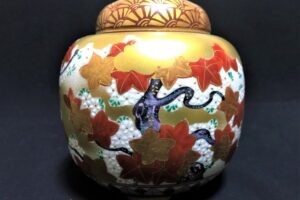
二元論的分岐:磁器 対 陶器While Western porcelain manufacturers like Meissen or Sèvres stacked gold leaf and intricate enamel paintings upon a pristine white surface to project a monument to human sovereignty (the weight of addition)…
The Japanese potter left the clay raw, yielding to the chaotic gravity of the fire.
Within the asymmetrical, warped contours of a rustic bowl, there exists a sacred “vacuum” (the void).
Because the vessel is deliberately incomplete, it leaves an open doorway for the guest’s imagination and spirit to enter and complete its beauty.
Act III:
Kintsugi
Aesthetic Repair:
Turning the Scar into the Crown
Just as we celebrate the black wrinkles of Kuromame as an elegant affirmation of age, the Japanese developed the world’s most high-density spiritual protocol for healing broken matter:
Kintsugi (Golden Joinery).
When a precious vessel breaks, Western restoration seeks to erase the event.
Using advanced adhesives, they seamlessly mask the fracture, desperately trying to restore the object to its “original, pre-shattered state”
—denying the irreversibility of time.
Kintsugi rejects this denial.
Using urushi (natural tree sap) and absolute patience, the craftsman joins the shattered fragments.
But rather than hiding the scars, they highlight the cracks in rivers of pure gold.
This is the ultimate “Aesthetic Debugging.”
The broken vessel (the system crash) is not thrown away as trash.
Instead, the “error” itself is elevated to become the central aesthetic narrative.
The vessel becomes infinitely more beautiful and spiritually valuable than it was before the break.
By accepting the fracture and sealing it in gold, Kintsugi proves that trauma, failure, and the inevitable decay of our physical vessels are not anomalies to be hidden.
They are our greatest histories
—the gilded, unhackable code of our resilience.
Act IV:
The Wheel of Anan-chō
Shedding the Cognitive Ego
During the Reviendrai pilgrimage, guests find themselves seated before a spinning potter’s wheel in the quiet forests of Anan-chō.
Whether enveloped in the deep, whispering green of summer or the silent frost of winter, the mountain air remains pristine, and time itself stands frozen.
Before them spins a wet, cold column of clay.
The moment the guest touches the clay, a silent, unforgiving physical dialogue begins.
If they apply too much force—the rigid desire to dominate (Gō / Ego)—the clay collapses in an instant.
If they are too passive, the clay remains a slumped, formless mound.
To shape the clay, they must subtract their own ego.
They must soften their palms and find the perfect receptive harmony (Jū / Subtraction), aligning their heartbeat with the centrifugal force of the wheel and the wet weight of the earth.
The resulting vessel—warped, imperfect, and thick with the finger-marks of its creator—is not just an object.
It is a three-dimensional printout of the guest’s soul at that exact, fleeting millisecond of existence.