The Metaphysics of Umami
Miso, Soy Sauce, and the Subtractive Firewalls of Fermentation
If Western gastronomy commands the palate through the “weight of addition“
—roasting vast slabs of animal flesh to consume their physical, caloric mass, and stacking complex fats to satisfy the primal brain…
The Japanese have quietly perfected a different paradigm:
the decompilation of the earth.
By taking the bean—a tiny, hard, almost impenetrable crystal of vegetable protein—and hacking its molecular structure through the invisible operations of microbes, they did not stack calories.
Instead, they liquefied the solid, subtracting its physical mass to extract pure, raw “Umami.”
This is the ultimate subtractive intelligence:
bypassing the aggressive, heavy noise of animal fats to install the quiet, self-sustaining harmony of the soil directly into our biological operating system.
Act I:
The War-State Survival OS
A Highly Portable, Concentrated Infrastructure
In the bloody, unstable chaos of the Sengoku (Warring States) period, victory was not won by the sharpest sword or the heaviest physical armor (Gō / Addition / Hardware).
It was ultimately decided by the cold, mathematical reality of logistics
—the preservation of the soldier’s vital force.
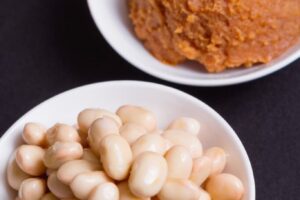
While Western armies dragged heavy carts of salted meats and provisions, Japanese samurai marched into battle with Miso-dama (dehydrated miso spheres) tied directly to their waists.
This was the ultimate subtractive ration.
By physically removing all excess water and weight, miso was compressed into a highly portable, concentrated infrastructure.
Mixed with a cup of boiling water on the freezing battlefield, it instantly booted up the soldier’s body, installing essential salts, protective amino acids, and thermal energy in a single, elegant step.
The ultimate architect of this survival OS was Tokugawa Ieyasu.
He conquered the turbulent realm not through brief, erratic flashes of genius, but through sheer longevity
—he out-survived every rival of his age.
The Gravity Shield of Hatcho
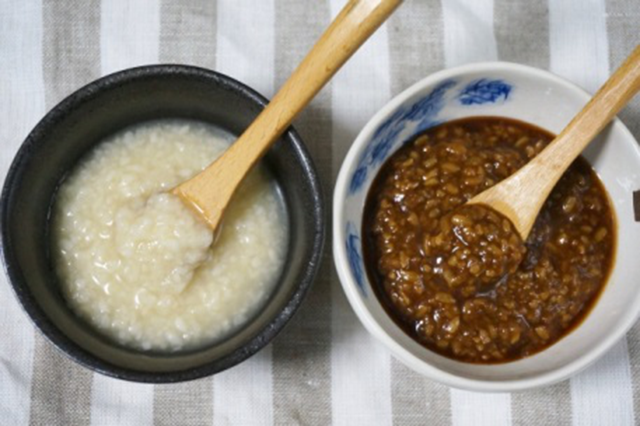
The secret shield of his cellular network was Hatcho Miso, crafted under his direct protection in his native Okazaki.
To make Hatcho Miso, master craftsmen fill giant, ancient wooden vats with raw soybeans, water, and salt.
Then, they perform a stunning, monumental ritual of gravity:
they hand-stack three tons of raw river stones into a perfect, interlocking cone atop the lid.
This immense, heavy crown of stone forces absolute, unyielding pressure and hermetic silence upon the dark interior.
Left in this state of physical imprisonment for over two summers and two winters, the mixture refuses to rot, surrendering instead to the rhythmic, changing seasons of the earth.
The constant, crushing gravity of the stones “debugs” the raw, erratic bitterness of the soy protein, decompiling it over years into a stable, pitch-black compiler of profound flavor.
By consuming this fermented shield daily, Ieyasu installed an internal antivirus, guarding his physical assets against ageing and decay, and calmly out-waiting every violent storm of his century.
Act II:
Soy Sauce
The Decompilation of Matter
If sake—the transparent white spirit of rice—is a symbol of Shinto’s celestial light, then Shōyu (Soy Sauce) is the deep, dark compiler of the earth’s shadow.
To make soy sauce is to perform a complete, molecular decompilation of matter.
Over thousands of hours of silent fermentation, invisible molds, lactic acid bacteria, and yeasts systematically dismantle the tough, dense proteins of soybeans and wheat, dissolving them into a pristine, liquid essence of amino acids.
This dark liquid represents the ultimate triumph of Far Eastern subtraction over the additive frenzy of the Western Age of Sail.
The Sterilization Firewall
In the 15th and 16th centuries, European powers launched armada after armada, spilling blood across stormy seas to monopolize Eastern spices like pepper, cinnamon, and cloves.
Why?
Because their culinary OS desperately needed an additive cover to mask the foul stench of decaying winter meats.
They stacked strong aromas to hide the rot.
Japan, however, sat in absolute, non-violent silence behind the closed borders of Sakoku (the closed sanctuary).
They had no need for the global spice trade.
They already possessed the ultimate sterilization firewall:
Soy Sauce.
The massive osmotic pressure, natural organic acids, and micro-alcohols naturally born in the long fermentation of Shōyu act as a microscopic shield, instantly destroying food-borne pathogens at a cellular level.
Rather than covering decay with layers of spices (the noise of addition), the Japanese used a single brush of soy sauce to subtract all bacterial anomalies, allowing them to safely consume raw fish (Sashimi) in its most pristine, unadulterated state.
Soy sauce is not a seasoning designed to overwhelm the ingredient;
it is a universal flavor compiler, translating the wild, unrefined notes of nature into a civil, harmonious, and highly digestible code.
Act III:
Umami
Discovered in 1908 by the Japanese chemist Kikunae Ikeda in the quiet depths of kelp dashi, Umami (Glutamate) is recognized as the fifth basic taste.
Yet, it is entirely different from the Western cardinal tastes of sweet, sour, salty, and bitter.
Those are additive, aggressive stimulants that shock the tongue’s receptors.
Umami, however, is a sensorial void
—the taste of subtraction.
The Sensorial Void of “Know-Sufficing”
Western classical sauces command the tongue by stacking dairy fats, heavy creams, and animal reductions (the weight of addition).
Japanese Dashi (broth), by contrast, is completely clear and fat-free
—essentially, transparent water.
Yet, the moment it touches the tongue, it gently opens the deep, hidden receptors of our cells, releasing a profound, resonant echo (Zanshin) that vibrates down the throat long after the liquid has vanished.
This is the exact same “subtractive sweetness” we experience in the Zen botany of green tea.
When we perform the subtraction of light (Gyokuro or Matcha), we freeze pure, sweet amino acids (L-Theanine) inside the cellular membrane, allowing the guest to drink the silent peace of the shade.
Both the clear Dashi and the emerald tea leaf are designed not to excite the mind, but to quiet the breath.
It is the taste of the Zen stone basin, the Tsukubai, inscribed with the code:
Ware, tada, taru, wo, shiru
(“I only know what is enough”).
By debugging fat and sugar from our diet and attuning our tastebuds to the transparent depth of Umami, we access an existential sanatorium.
It is a taste that whispers the ultimate luxury of sufficiency:
the quiet, peaceful realization that we already have enough, releasing our spirits from the restless, noisy desires of an additive world.
Act IV:
The Alchemical Palette of the Fault Line
Attuning the Five Senses
To subtract all excess noise and extract the very “core of existence”
—The metaphysics of Umami we have decoded here through logos breathes silently yet vividly in the harsh winters of Tenryu Village.
Stuffing miso into a hollowed yuzu, exposing it to the freezing wind, and letting it quietly cure as if “drying and embodying time itself.”
This is the ritual of Yubeshi.
It is nothing less than the “absolute zero of taste” that Rikyu cherished and medieval monks contemplated in silence.