
Spectroscopy of Emerald
The Botany of Subtraction and the Compilation of the Spirit
As a matter of cold, objective fact, every single cup of tea on this planet—from Western Black Tea to the Far East’s Matcha and Sencha—originates from the exact same botanical source:
a single evergreen tree known as Camellia sinensis.
Yet, why do we pour them into such vastly different vessels?
Why do we approach them through entirely separate protocols of consumption, letting them trigger entirely separate states of consciousness?
Here lies the Great Divide of human intelligence:
the collision between the Western desire for “Addition“ and the Far East’s mastery of “Subtraction.”
It is the most tender, yet fiercely radical alchemy of meaning ever engineered by human culture.
Act I:
The Force-Quit of Time
Western Addition
The Western Addition (Black Tea) lineage embraces the natural decay of time—oxidation and fermentation—letting it run its course to the absolute limit.
Upon this oxidized foundation, it aggressively stacks layers of additive gratification:
cane sugar, milk, and the artificial zest of bergamot oil.
It is a monument to the architecture of heavy addition.
Much like the exquisite mastery of the Viennese Sacher-Torte—where the deep complexity of chocolate is layered with sweet apricot jam and served with a cloud of whipped cream—it is a flavor engineered as a magnificent monument of sensory abundance, celebrating the height of courtly refinement.
Eastern Subtraction
In sharp contrast, the Green Tea of the Far East performs an act of structural defiance within mere hours of harvest:
the protocol of steaming or pan-firing.
By introducing immediate, controlled heat, the craftsperson permanently deactivates the plant’s internal fermentation enzymes.
The natural clock of oxidation is instantly, irrevocably force-quit.
This is a profound, non-violent resistance against the erosion of time.
Rather than surrendering the leaf to the natural decay of the atmosphere, the Far East freezes the raw, emerald purity of the present moment, locking the unadulterated memory of the earth into a cellular vault.
Every green tea on earth boots up from this foundational infrastructure of temporal subtraction.
Act II:
The Botany of Subtraction
The Climate Firewall
The finest shade-grown tea is never produced under the blinding glare of raw industrial efficiency.
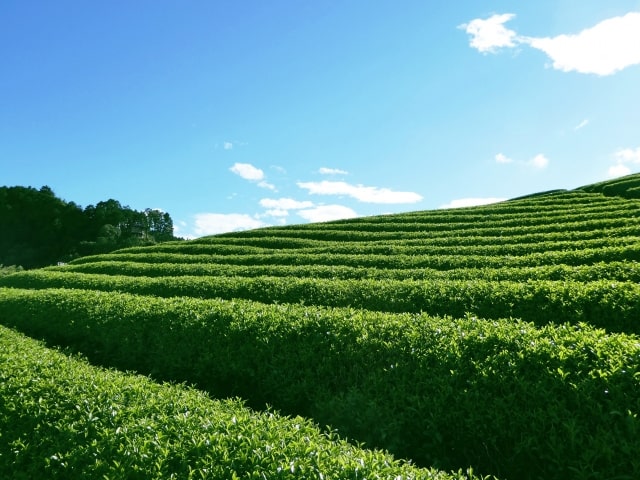
The fields clinging precariously to the vertical alpine slopes are systematically cast into shadow using screens of straw, or wrapped in the thick, silent blankets of natural morning mist (Kiri) rising from the deep river gorges.
This is a climate firewall designed to block out up to 99% of solar radiation.
Deprived of light—the aggressive “additive” stimulus of the sun—the leaf is liberated from the stress of photosynthesis.
By subtracting this environmental noise, the plant halts the production of bitter catechins and tannins.
Instead, it quietly hoards the pure, sweet amino acids (L-Theanine) drawn up from the deep tectonic roots, freezing them inside the cellular membrane.
Act III:
Matcha as a Heavy “Desktop OS”
The Complete Dissolution of Boundaries
In the historical timeline of the Far East, the first complete spiritual ecosystem to reach maturity was Matcha.
Technologically, the Song Dynasty Codes of tea-whipping were brought to Japan in the late 12th century by Zen monks, who re-compiled them into a heavy, uncompromising spiritual operating system.
While this culture was eventually erased from the continental strata of China, it found its ultimate sanctuary in the isolated archipelago of Japan.
The botanical software
In the creation of Matcha, the dried leaf (Tencha (碾茶)) meets its ultimate sacrifice beneath the immense gravity of traditional granite stone mills.
These stones are permitted to rotate only at an incredibly low frequency—precisely one revolution per second.
To accelerate the process would introduce frictional heat, causing the sacred chlorophyll to oxidize and instantly crashing the brilliant emerald green into a dead, muddy brown.
Under the meditative crushing of the stone mill, the three-dimensional hardware of the leaf—its veins, ribs, and fibers—is completely decommissioned.
Matter is dematerialized and converted into a formless, non-reflective emerald dust of less than 10 microns.
It is pure, disembodied spiritual software.
Ichiza Konryu (一座建立)
When the host whisks this emerald dust into hot water, allowing the guest to consume the entire leaf as a single, flawless suspension, the botanical hardware of the plant is completely absorbed.
The physical boundary between leaf and water, self and other, dissolves.
This is the zero-point harmony of Ichiza Konryu (一座建立)
—where the physical matter of the leaf liquifies into the blood, completing the total liquidation of the individual ego into the cosmos.
Act IV:
Sencha as a “Self-Extracting Device”
The Micro-Engineering of the Cellular Membrane
However, the Far Eastern intellect did not stop at the closed tea room.
In the mid-18th century, a staggering technological breakthrough occurred, giving birth to Sencha
—the mobile operating system of Zen.
Matcha achieved instant extraction by completely destroying the leaf’s physical form.
Sencha, conversely, set out to achieve an impossible paradox:
to preserve the beautiful, raw, physical structure of the needle-like leaf while allowing it to release its deepest sweetness and aroma instantly, using nothing more than a simple pour of warm water.
The self-extracting micro-device
Over agonizing hours upon a heated table, the master artisan applies a precise, rhythmic pressure with their palms, rolling the steamed leaves by hand.
This divine pressure achieves a microscopic miracle:
it fractures the internal cellular membranes of the leaf at a millimeter scale, without disrupting its external three-dimensional architecture.
The craftsperson who unlocked this code was Nagatani Sōen, who invented the Temomi (hand-rolling) micro-engineering protocol.
As the rolled leaf dries, it tightens into a gorgeous, dark-green pine needle.
But the leaf itself now carries the entire extraction program within its engineered membrane.
By transforming the physical leaf into an on-demand, self-extracting micro-device, the Far East achieved a staggering technological compression.
Act V:
The Somatic Postscript
Consuming the Sacrificed Body
While the formal choreography of the tea gathering is complete and the warm, emerald liquid is drained, there remains a final, highly intimate, and unwritten chapter
—one reserved not for the rigid pages of public tea manuals, but for the quiet, sacred trust between the innermost circle of host and guest.
This is the esoteric communion of the spent leaves (chagara).
When the gathering is illuminated by the highest grade of organic, pesticide-free Sencha or Gyokuro, the physical body of the leaf is never treated as waste to be casually discarded.
Instead, after the final pour has sung its essence, the host places the warm, softened leaves directly onto the table alongside the light meal or sweets, offering them with a gentle, unaffected whisper:
“These leaves are far too beautiful and precious to throw away.”
As a matter of physiological fact, hot water can extract only about 30% of the leaf’s total alchemy (the volatile, soluble elements like L-theanine and soluble catechins).
The remaining 70% —the rich, insoluble vitamins A, C, and E, beta-carotene, and dense dietary fibres—remains locked inside the softened green flesh of the spent leaf.
Dressed with a mere drop of aged, gravity-pressed soy sauce, it is served not as a theatrical show, but as a tender, private gesture of hospitality reserved only for those closest to the heart.
It is a silent, somatic Mass.
Epilogue:
The Two Folded Universes
When a traveler sits before these two distinct vessels—the clear, translucent amber-green of Sencha and the deep, velvety emerald foam of Matcha—we present them with a singular question:
“One lineage asks the physical body to remain anchored in the pot, sending only its invisible fragrance to play in the water
—a beauty born from distance and restraint.
The other lineage demands that the leaf shatter its physical self completely, merge with the warm water, and dissolve into your very bloodstream
—a beauty born from absolute communion.”
Both worlds are folded inside the exact same green leaf.


Harvest the Liquid Emerald at Tenryu ➔
This aesthetics of ‘Spectroscopy of Emerald’ breathes in the deep tea fields on the sheer slopes of Tenryu Village.
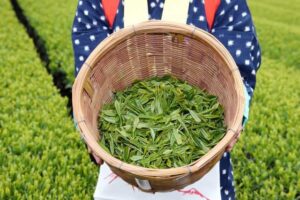
To reach out and pluck that shimmering emerald leaf, nurtured by the morning mists and freezing mountain winds, with your own hands.
This is no mere agricultural task.
Use your five senses as a prism.
Step onto the quiet mountain slopes to feel and draw that green light directly into your being.