The Aesthetic Resistance
The Subtractive Infrastructure of the Chashitsu and the Sovereignty of Silence
In a modern civilization dominated by “the weight of addition“
—where capital, data, and material desires are aggressively stacked to fuel the expansion of the self…
What, then, is the true nature of Japanese Teaism (Chanoyu)?
Tea has not the arrogance of wine, the self-consciousness of coffee, nor the simpering innocence of cocoa.
It is a quiet, profound medium that demands your full presence.
Teaism is not a polite social custom or a set of rigid dining manners.
It is a “subtractive infrastructure” designed to save the human soul from the suffocating noise of materialism.
It is a sacred system of “Aesthetic Resistance”
Act I:
The Security Protocols of the Chashitsu
Force-Quitting the Social Ego
The path leading into the tea room (Chashitsu) is a physical, architectural series of “firewalls.“
Rikyū designed this space to systematically strip away, debug, and shut down the guest’s worldly program before they are permitted to touch the sacred.
The Roji (Dewy Path)
— Cognitive Detoxification:
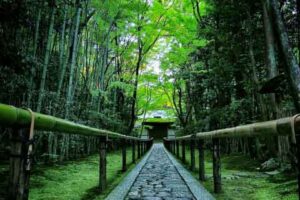
In Buddhist parables, the Roji represents the cool, damp ground outside the “burning house” (Sangai no Kataku) of our worldly passions.
As the guest steps onto the mossy stones, hears the wind whisper through the trees, and rinses their hands at the stone basin (Tsukubai), they are not just cleansing physical dirt.
They are undergoing a systematic “Cognitive Detoxification“.
The Sword Rack (Katana-kake)
— Decoupling Violence:
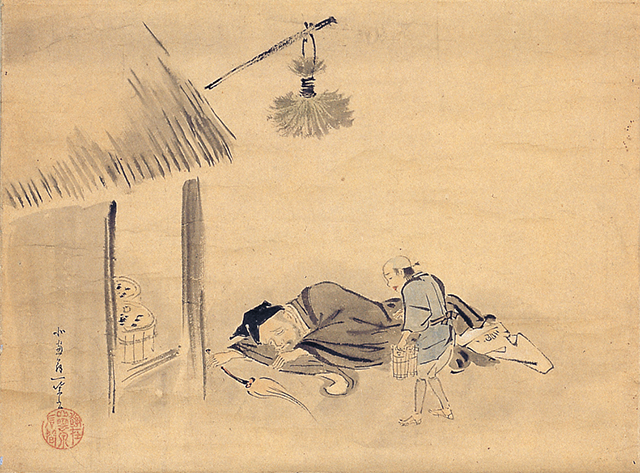
Outside the tea house, beneath the rustic eaves, hung a simple wooden rack.
The samurai, whose swords were the absolute symbol of their rank and their physical power over life and death, had to leave their weapons outside.
Within this fragile plaster cocoon, physical violence was completely decoupled from the system.
All men met as equals, disarmed and returned to their naked humanity.
The Nijiriguchi (Crawling Entrance)
— The Absolute Force-Quit:
To enter the room, guests sometimes have to pass through the Nijiriguchi
—a tiny square opening less than three feet high.
To crawl through this narrow wooden birth canal, everyone—from the supreme regent to the humblest merchant—must bow down, drop their neck, and crawl on hands and knees.
It is a physical “Force-Quit“ of the social ego.
By shedding your public title (your “false name”), you pass through the birth canal to be reborn as a pure, unadulterated individual.
Act II:
The Acoustics of Silence
The Engineering of the Void
The silence inside the Chashitsu is not the cold, lifeless absence of sound.
It is a highly engineered, dynamic “Acoustic Sanctuary.”
To prevent the human mind from racing, Rikyū placed small iron plates inside the bottom of the heavy cast-iron kettle (Kama).
When the water boils, the steam rising through the iron creates a peculiar, whispering vibration.
Rikyū described this sound as Matsukaze (wind sighing through the pines) or “the distant echo of a cataract muffled by clouds.”
By filtering out the harsh, artificial noises of society, this natural frequency gently attunes the guest’s brainwaves to the rhythm of the earth.
It is an exquisite “Aesthetic Noise-Reduction System,” enabling the soul to finally hear the whisper of its own inner light.
Act III:
The Masterpiece of the Unfinished
Co-Creating the Shamanic Loop
Western classical art seeks to present a completed, symmetrical masterpiece.
It is a closed book;
the viewer can only stand outside and admire the artist’s completed thoughts.
Teaism, however, is “the worship of the Imperfect.”
By intentionally breaking symmetry, leaving a plaster wall rough and unfinished, or presenting a cracked bowl, the host creates an “Aesthetic Vacuum” (the void).
Because the vessel is deliberately incomplete, it acts as an irresistible cognitive hook.
The guest cannot remain a passive spectator;
their own imagination and intellect are forced to step inside, bridge the gaps, and complete the masterpiece with their own spirit.
It is an encounter where the guest is elevated from a mere consumer into the active co-creator of the sacred moment.
Act IV:
The Metaphysics of Wabi-Sabi
Within this quiet, shadow-drenched vacuum, the Far East’s spiritual operating system crystallizes into Wabi-Sabi.
Far from being a passive appreciation of “rustic old things,” it is a highly active, militant strategy of Aesthetic Sovereignty.
Wabi
Reclaiming the Soul’s Autonomy:
Wabi is not the miserable, desperate poverty of a beggar (passive deprivation).
It is the active, heroic appreciation of simplicity.
It is the voluntary subtraction of material excess to reclaim absolute control over one’s own desires.
The Wabibito (the person of tea) is completely free in their heart because they have voluntarily removed the heavy weight of material concerns from their life.
It is the ultimate luxury of needing nothing, releasing the soul from its enslavement to the consumer market.
Sabi
Embracing Temporal Erosion:
Sabi is the celebration of time’s irreversible mark upon matter.
While Western classical architecture used stone and marble to wage a futile war against decay—the illusion of immortality—the Japanese chose to align their spirit with the natural cycle of decay.
A crumbling mud wall, a slightly warped tea bowl
—these “scars” are not system errors.
They are the beautiful, golden records of existence.
By accepting the erosion of time, the vessel becomes a three-dimensional screen displaying the deep, unyielding truth of the cosmos.
Act V:
Ichigo Ichie
The Phenomenology of Frozen Time
Once the guest has been stripped of their armor, crawled into the dim, quiet vacuum of the room, and attuned their ears to the acoustics of the boiling kettle, they confront the ultimate temporal protocol of Zen:
Ichigo Ichie
(One Time, One Meeting).
This bowl of tea, this exact gathering of people, the sound of the wind through the pines outside, the specific slanting light filtering through the paper screens
—this exact configuration of the universe has never happened before, and will never happen again for all eternity.
Ichigo Ichie is not a warm, sentimental slogan of hospitality.
It is a highly sophisticated Aesthetic Attunement Protocol.
By injecting the raw, irreversible nature of time into the encounter, the host forces the guest’s consciousness to freeze.
All regrets about the past and anxieties about the future (the noise of addition) are instantly subtracted from the brain.
The guest is locked 100% into the absolute “Here and Now” (Ichigo), transforming a transient cup of warm tea into an eternal, unforgettable milestone of the soul.
Epilogue:
The Gateway to the Sovereign Code
When the guest finally steps back out across the mossy stones of the Roji, having left their societal armor in the dirt and experienced the ultimate clearing of cognitive noise, they are no longer the same traveler who arrived.
They have tasted the Void.